This year’s AWS Community Day Aotearoa felt very different from the last few years. The conversations have matured, the demos are sharper, and the big shift I sensed is that agentic AI and conversational development are no longer just experimental curiosities — they’re becoming part of mainstream engineering workflows.
The event was brought to life by AWS Heroes, community builders, ambassadors, and a buzzing group of professionals who carved time out of their work schedules to share ideas, debate, and learn. While the keynotes were important, it was the breakouts and hallway conversations that gave the clearest signal of where things are heading in AWS Cloud, Developer workflow, and AI frontiers.
Below, I’ve structured my reflections session by session — what I learnt, what resonated, and why I think it matters for practitioners in New Zealand and beyond.
Speaker: Russell Hall - ANZ Country Lead @ Amazon Kuiper Commercial Services
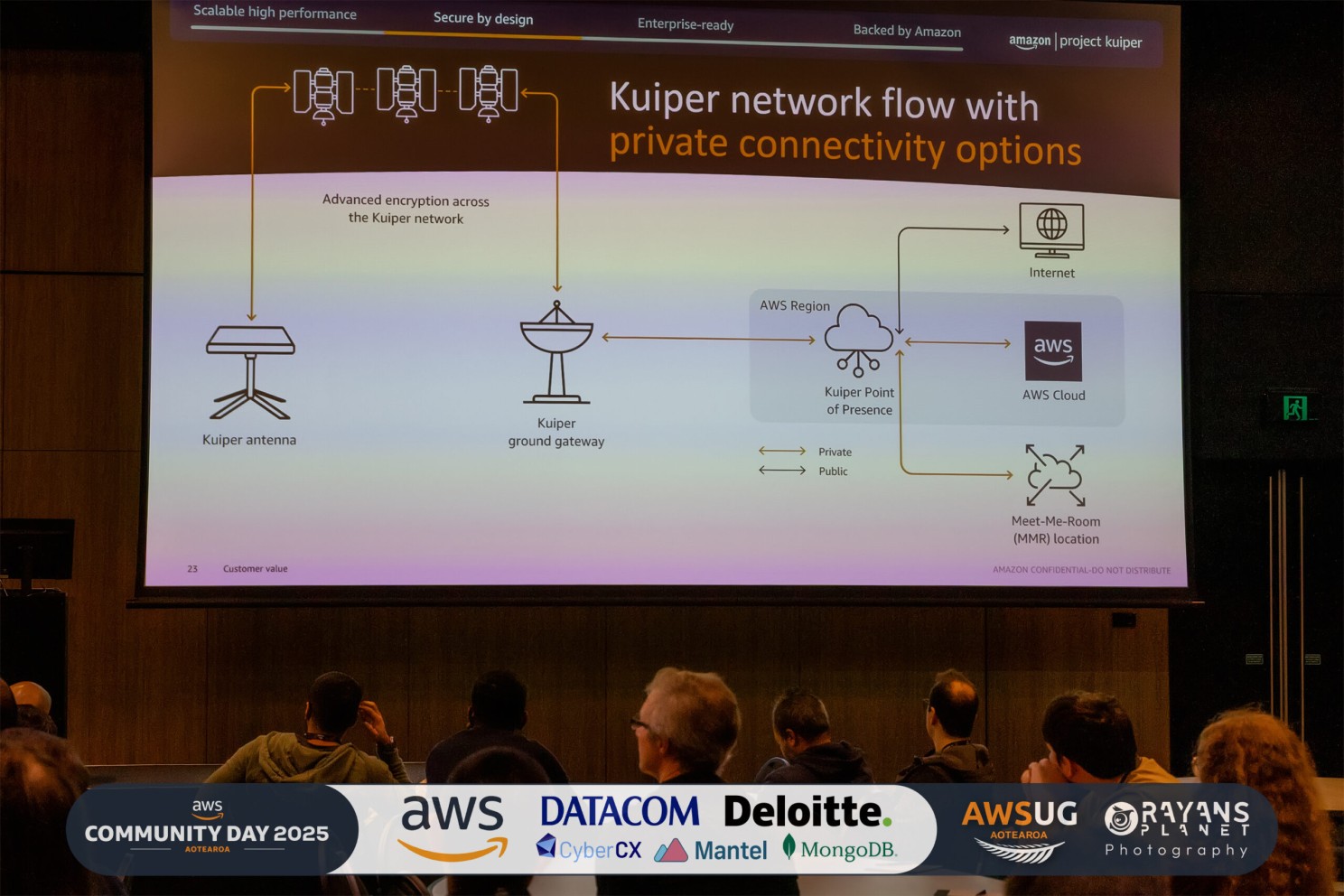
Project Kuiper has been in the news for a while, but Russell’s session reframed it for local context. Kuiper isn’t just about giving broadband to remote farms. It is being built as an enterprise-ready, scalable, high-performance connectivity layer — secure by design and backed by Amazon.
The key point: by mid-2026, New Zealand businesses and consumers will be able to tap into Kuiper for fast, reliable internet and private connectivity options to AWS Cloud.
What stuck with me is how Kuiper could rebalance access between metro and regional businesses. In Aotearoa, where geographical spread and network disparity remain stubborn challenges, this is more than infrastructure. It’s an equaliser.
Takeaway for technologists: start thinking about what it means when cloud access is no longer bottlenecked by fibre availability. Latency-sensitive workloads, distributed data architectures, and even disaster recovery strategies could look very different once Kuiper is live.
Speaker: Michael Walmsley - AWS Serverless Hero - AWS Solution Architect @ Accenture
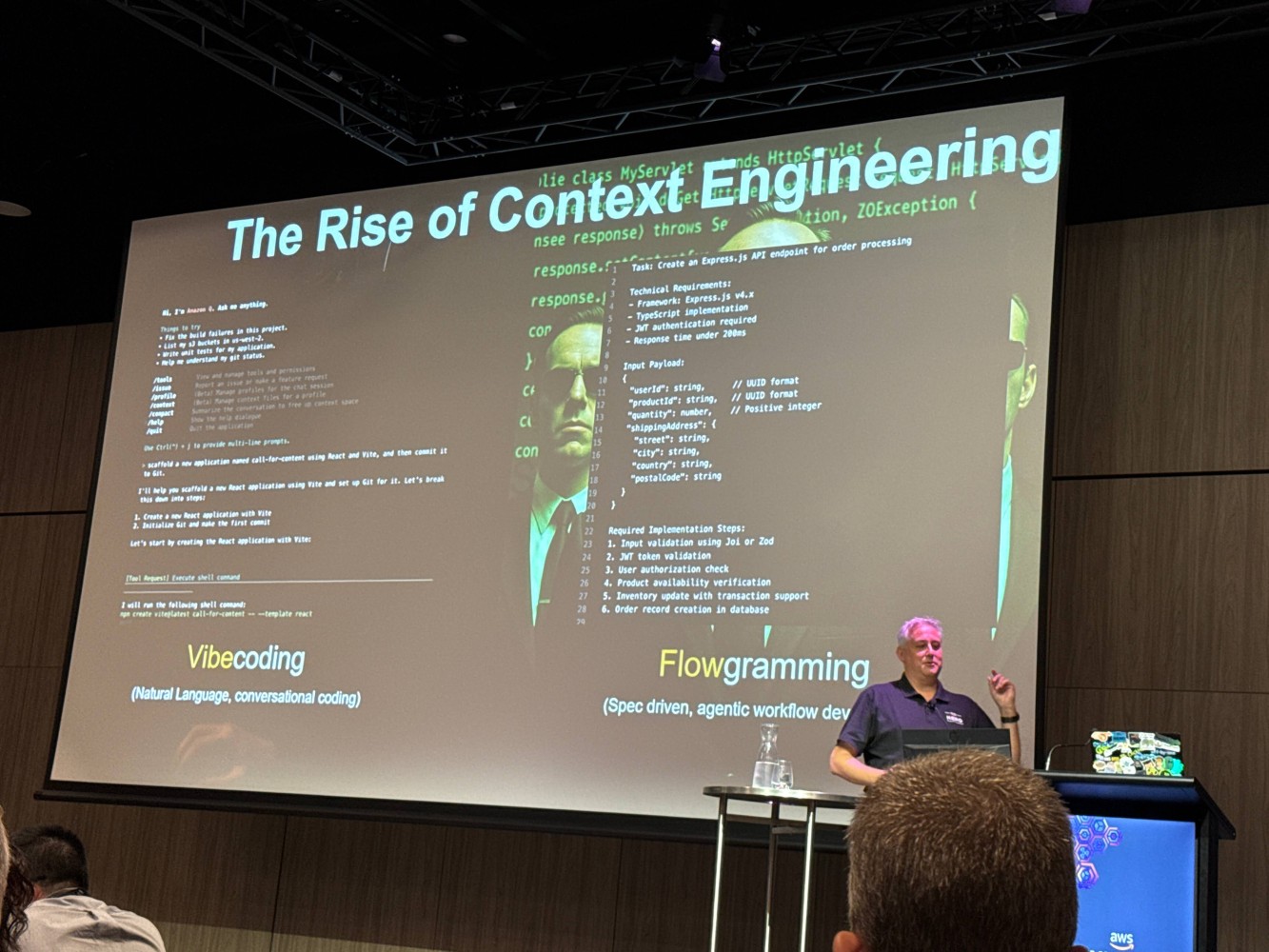
Michael’s session was one of the most thought-provoking of the day. His line that “the hottest new language is English” landed because it captured the essence of what many of us are already seeing: coding is shifting from writing syntax to problem-solving through natural language.
He unpacked the conversation-first approach:
This isn’t about “prompt engineering” in the narrow sense anymore. It’s about context engineering.
Two terms stood out:
Vibe coding – natural language, conversational development.
Flowgramming – specification-driven, agentic workflow development.
For flowgramming to work, you need discipline: time spent creating specifications, structured prompting, building project intelligence, and using MCP plugins effectively.
Takeaway for technologists: the bar is rising. It’s no longer enough to know the syntax of a cloud SDK. You need to think in terms of workflow orchestration, prompt design, and system-level reasoning.
Speakers: Kasun de Silva & Michael Gealogo - Engineers @ Xero
This was a very practical session. They showcased how AWS Lambda can be used as compute for AWS CodeBuild runners within GitHub Actions.
The benefits were clear: lightning-fast execution for tasks such as linting checks, security scans, small builds, and deployments. But it’s not universal. Docker image builds won’t fit (time caps are 15 minutes).
What I liked was the pragmatism: this isn’t about replacing an entire CI/CD pipeline. It’s about picking the right workloads for Lambda-powered CodeBuild and squeezing out efficiency where it makes sense.
Takeaway for technologists: if your CI/CD pipelines are dragging under the weight of trivial but frequent jobs, this pattern is worth exploring.
Speaker: Roberto Allende - Team Lead @ MetService - AWS & GenAI Hackathoner
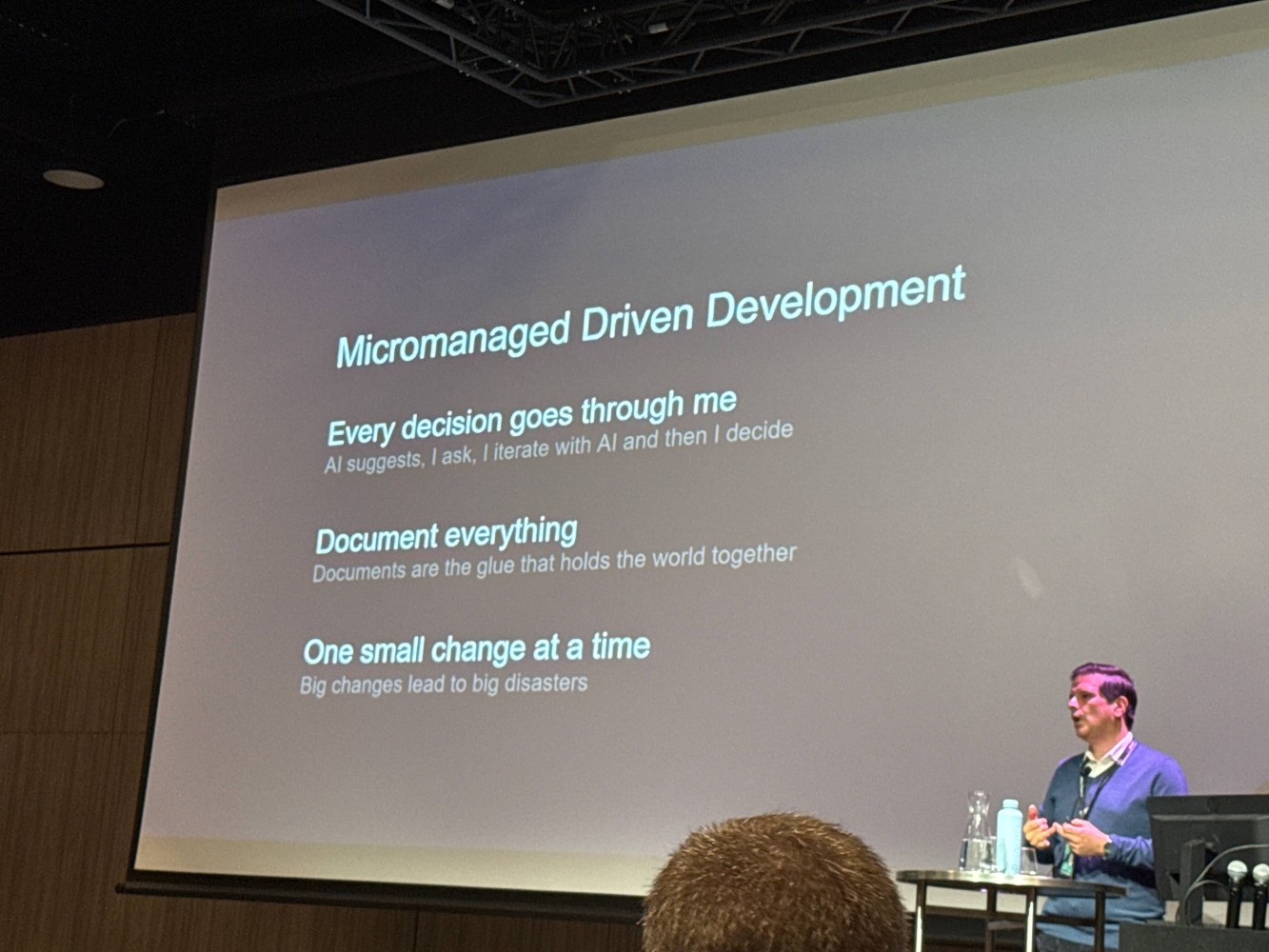
Roberto’s talk was equal parts inspiring and cautionary. He walked us through a hackathon where he built a full application with Amazon Q — and then detailed the methodology he coined: Micromanaged Driven Development (MMDD).
The essence of MMDD:
He demonstrated this by showing how you could ask Amazon Q structured questions like:
With Q, iteration cycles shrink dramatically — from week-long loops to daily loops. But Roberto also flagged the trade-offs:
Takeaway for technologists: AI is a powerful co-pilot, but discipline in documentation and granular decision-making is non-negotiable. Otherwise, the gains in speed are outweighed by chaos in governance.
Speaker: Bo Tu - Senior Engineer from Platform @ Xero
Kubernetes scaling is often about compute or cost, but Bo reminded us that IP exhaustion is a silent killer of cluster growth.
He offered several fixes:
Takeaway for technologists: don’t let your Kubernetes scaling plans be derailed by an avoidable IP problem. Have an IPv6 strategy on the table — even if you’re not ready to adopt it immediately.
Panellists:
This insightful panel discussion highlighted perspectives from leaders within Aotearoa’s cloud ecosystem. The speakers shared their experiences related to professional development, collaboration, and opportunities facilitated by meetups, mentoring, and knowledge exchange.
I was truly inspired by what I heard and felt compelled to compose this piece. Ordinarily, I share my key insights from events with my colleagues at Datacom, but on this occasion, I chose to take a further step and contribute to the wider Community—a source from which I have gained significant knowledge and motivation to continuously refine my skills.
Part 2 of this article can be found here.
#AWSCDNZ25 #AWSCommunity #awscommunitybuilders #Wellington #NewZealand #EventHighlights
The event was brought to life by AWS Heroes, community builders, ambassadors, and a buzzing group of professionals who carved time out of their work schedules to share ideas, debate, and learn. While the keynotes were important, it was the breakouts and hallway conversations that gave the clearest signal of where things are heading in AWS Cloud, Developer workflow, and AI frontiers.
Below, I’ve structured my reflections session by session — what I learnt, what resonated, and why I think it matters for practitioners in New Zealand and beyond.
1. Beyond Boundaries: The Kuiper Revolution for New Zealand’s Enterprises (Keynote)
Speaker: Russell Hall - ANZ Country Lead @ Amazon Kuiper Commercial Services
Project Kuiper has been in the news for a while, but Russell’s session reframed it for local context. Kuiper isn’t just about giving broadband to remote farms. It is being built as an enterprise-ready, scalable, high-performance connectivity layer — secure by design and backed by Amazon.
The key point: by mid-2026, New Zealand businesses and consumers will be able to tap into Kuiper for fast, reliable internet and private connectivity options to AWS Cloud.
What stuck with me is how Kuiper could rebalance access between metro and regional businesses. In Aotearoa, where geographical spread and network disparity remain stubborn challenges, this is more than infrastructure. It’s an equaliser.
Takeaway for technologists: start thinking about what it means when cloud access is no longer bottlenecked by fibre availability. Latency-sensitive workloads, distributed data architectures, and even disaster recovery strategies could look very different once Kuiper is live.
2. Maximise your VIBE with Powertools and Amazon Q Developer
Speaker: Michael Walmsley - AWS Serverless Hero - AWS Solution Architect @ Accenture
Michael’s session was one of the most thought-provoking of the day. His line that “the hottest new language is English” landed because it captured the essence of what many of us are already seeing: coding is shifting from writing syntax to problem-solving through natural language.
He unpacked the conversation-first approach:
- Specification – using Amazon Q to generate step-by-step specifications.
- Implementation plan – blueprinting and prompting plans.
- Coding execution – letting Amazon Q carry out the plan step by step.
- State management – storing all of this in a Git repository.
This isn’t about “prompt engineering” in the narrow sense anymore. It’s about context engineering.
Two terms stood out:
Vibe coding – natural language, conversational development.
Flowgramming – specification-driven, agentic workflow development.
For flowgramming to work, you need discipline: time spent creating specifications, structured prompting, building project intelligence, and using MCP plugins effectively.
Takeaway for technologists: the bar is rising. It’s no longer enough to know the syntax of a cloud SDK. You need to think in terms of workflow orchestration, prompt design, and system-level reasoning.
3. AWS CodeBuild Meets GitHub Actions – A Modern Take on CI/CD Efficiency
Speakers: Kasun de Silva & Michael Gealogo - Engineers @ Xero
This was a very practical session. They showcased how AWS Lambda can be used as compute for AWS CodeBuild runners within GitHub Actions.
The benefits were clear: lightning-fast execution for tasks such as linting checks, security scans, small builds, and deployments. But it’s not universal. Docker image builds won’t fit (time caps are 15 minutes).
What I liked was the pragmatism: this isn’t about replacing an entire CI/CD pipeline. It’s about picking the right workloads for Lambda-powered CodeBuild and squeezing out efficiency where it makes sense.
Takeaway for technologists: if your CI/CD pipelines are dragging under the weight of trivial but frequent jobs, this pattern is worth exploring.
4. Can You Build and Ship an Entire App Using Amazon Q?
Speaker: Roberto Allende - Team Lead @ MetService - AWS & GenAI Hackathoner
Roberto’s talk was equal parts inspiring and cautionary. He walked us through a hackathon where he built a full application with Amazon Q — and then detailed the methodology he coined: Micromanaged Driven Development (MMDD).
The essence of MMDD:
- Every decision routes through the developer (AI suggests, you decide).
- Document everything — markdown files act as glue.
- Make one small change at a time.
He demonstrated this by showing how you could ask Amazon Q structured questions like:
- What kind of documentation would be useful?
- What are the main AWS components to implement this idea?
- How would you break the project into baby steps?
With Q, iteration cycles shrink dramatically — from week-long loops to daily loops. But Roberto also flagged the trade-offs:
- Verification burden increases.
- Prompt decisions matter enormously.
- There’s always a risk of over-reliance on AI outputs.
Takeaway for technologists: AI is a powerful co-pilot, but discipline in documentation and granular decision-making is non-negotiable. Otherwise, the gains in speed are outweighed by chaos in governance.
5. Scaling Kubernetes on AWS by Solving IP Exhaustion
Speaker: Bo Tu - Senior Engineer from Platform @ Xero
Kubernetes scaling is often about compute or cost, but Bo reminded us that IP exhaustion is a silent killer of cluster growth.
He offered several fixes:
- The quick fix: add new subnets.
- The structural fix: shift to IPv6 EKS clusters.
- A more nuanced fix: cluster segmentation.
- Another lever: custom networking by adding a second CIDR range.
Takeaway for technologists: don’t let your Kubernetes scaling plans be derailed by an avoidable IP problem. Have an IPv6 strategy on the table — even if you’re not ready to adopt it immediately.
6. Panel discussion: Elevating Careers Through Cloud Community - Aotearoa Edition
Panellists:
- Darshit Pandya – Senior Principal Engineer, Platform at Serko | AWS Community Builder
- Geethika Guruge – Principal Consultant at Mantel | AWS Ambassador
- Seb Krueger – Cloud and AI Technology Leader | Community Builder | AWS User Group Aotearoa Co-Founder
- Hazelle Sevilla – Senior Solutions Architect at MongoDB
This insightful panel discussion highlighted perspectives from leaders within Aotearoa’s cloud ecosystem. The speakers shared their experiences related to professional development, collaboration, and opportunities facilitated by meetups, mentoring, and knowledge exchange.
I was truly inspired by what I heard and felt compelled to compose this piece. Ordinarily, I share my key insights from events with my colleagues at Datacom, but on this occasion, I chose to take a further step and contribute to the wider Community—a source from which I have gained significant knowledge and motivation to continuously refine my skills.
Part 2 of this article can be found here.
#AWSCDNZ25 #AWSCommunity #awscommunitybuilders #Wellington #NewZealand #EventHighlights
Comments
Post a Comment